
If you’re buying or leasing a vehicle in Colorado, you’ve probably heard someone say: “Make sure you get gap insurance.” But what is gap coverage — and do you actually need it?
Gap insurance can be a smart (and affordable) way to protect yourself from a common financial surprise: owing money on a vehicle that’s been totaled or stolen. Because auto insurance typically pays the vehicle’s value at the time of loss — not what you owe on your loan or lease — gap coverage can help protect you from paying thousands out of pocket.
In this guide, we’ll break down what gap insurance is, who it’s best for, and how Colorado drivers can decide whether it’s worth adding.
What Is Gap Insurance?
Gap insurance (Guaranteed Asset Protection) helps cover the “gap” between:
- What your auto insurance pays after a total loss, and
- What you still owe on your auto loan or lease
Auto insurance typically pays Actual Cash Value (ACV) — the vehicle’s market value at the time of loss — not what you originally paid or what your loan balance is.
So if your car is totaled or stolen and the ACV payout is less than your remaining loan/lease balance, you may still be responsible for the difference.
Quick example:
- You owe on your loan: $32,000
- Insurance ACV payout: $26,500
- Difference (“gap”): $5,500
Gap insurance may help cover that $5,500 (subject to policy terms).
Why This Matters in Colorado
Colorado drivers face a few conditions that make gap insurance extra relevant:
- Higher vehicle replacement costs (inflation + supply chain effects)
- Weather-related total losses (hail, flooding, wildfires)
- Winter driving accidents (I-70 corridor, mountain travel, black ice)
- Vehicle theft concerns in metro areas
Total losses can happen even when you’re doing everything right — and gap can help prevent a major financial setback.
Who Gap Insurance Is Best For
Gap insurance isn’t necessary for everyone — but it can be a great fit if any of the following apply.
1) You put down less than 20%
If you make a small down payment, you may owe more than the vehicle is worth in the early years of the loan.
Best fit: 0–10% down (or no down payment)
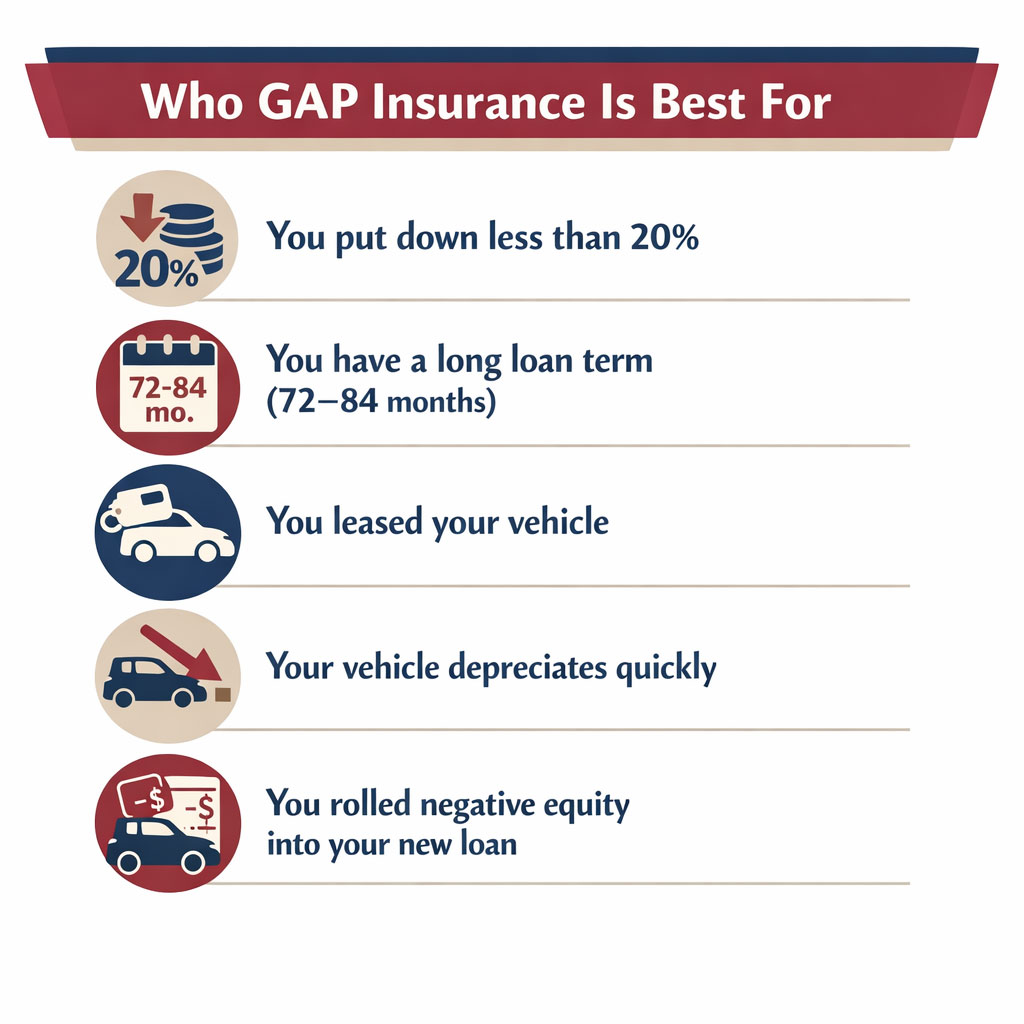
2) You have a long loan term (72–84 months)
Longer loans mean you build equity more slowly. Vehicles typically depreciate faster than your loan balance decreases — especially in the first 1–2 years.
Best fit: 72- or 84-month financing
3) You leased your vehicle
Most leases require you to maintain coverage, and gap is often recommended (sometimes built in, sometimes optional depending on your contract).
Best fit: leased vehicles (especially new cars)
4) Your vehicle depreciates quickly
Some vehicles lose value faster than others — particularly certain new models, luxury vehicles, and high-mileage-use vehicles.
Best fit: new vehicles that drop value quickly
5) You rolled negative equity into your new loan
If you traded in a vehicle and owed more than it was worth (negative equity), that balance can follow you into your new loan — increasing the chance you’ll be upside down.
Best fit: trade-ins with negative equity
When Gap Insurance May NOT Be Necessary
Gap coverage might not be needed if:
- You made a large down payment (20%+)
- Your loan term is short (36–60 months)
- Your car is already worth more than you owe
- You drive an older vehicle with low loan balance
- You have enough savings to cover a potential gap (just in case)
💡 Conexus tip: Gap insurance usually matters most in the first 2–3 years of ownership, when depreciation is steepest.
How Much Does Gap Insurance Cost in Colorado?
Costs vary based on your vehicle and insurer, but many Colorado drivers see it as a relatively affordable add-on.
Gap can be purchased:
- Through your auto insurance carrier (often the most cost-effective option)
- Through the dealership/lender (often more expensive; terms vary)
If you’re comparing options, focus on:
- the cost,
- coverage rules,
- and exclusions.
What Gap Insurance Typically Covers (and Doesn’t)
Gap insurance may help pay:
✅ the difference between your vehicle’s ACV payout and your loan/lease balance after a covered total loss
Gap insurance typically does not cover:
❌ missed payments or late fees
❌ extended warranties or credit insurance added to the loan
❌ wear and tear or mechanical issues
❌ a deductible (some policies include a small deductible waiver — it depends)
Because exact terms vary by insurer and lender, it’s important to review the policy details.
Gap Insurance vs. New Car Replacement Coverage
These sound similar — but they’re different.
Gap Insurance
Helps pay what you still owe.
New Car Replacement
Helps replace your vehicle with a new model year vehicle (usually only for newer cars, and only within a set time window)
In some cases, Colorado drivers may benefit from one or the other, or occasionally both — depending on their vehicle and financing.
How to Decide: Do You Need Gap Insurance?
Ask yourself these 5 questions:
- Did I put down less than 20%?
- Is my loan term longer than 60 months?
- Am I leasing?
- Would I struggle to pay a $3,000–$8,000 difference if my car was totaled?
- Did I roll negative equity into my loan?
If you answered “yes” to any of the above, gap coverage is worth considering.
How Conexus Helps Colorado Drivers Make the Right Call
At Conexus Insurance Partners, we’re big believers in protecting what matters — without overbuying coverage you don’t need.
We help Colorado drivers:
- review their current policy and coverages,
- understand if they’re upside down on their loan,
- compare gap options across carriers,
- and build coverage that fits their lifestyle and budget.
If you’re not sure whether gap insurance is worth it for your situation, we’ll help you confidently decide.
Final Takeaway: Gap Insurance Is Most Valuable When You Owe More Than Your Car Is Worth
Gap insurance is designed for one very specific moment — when your vehicle is totaled or stolen and you owe more than the value of the car.
If you’re financing with a small down payment, leasing, or using a long loan term, gap can be a smart safety net, especially in Colorado where weather and driving conditions can add risk.