

If you’re like most Colorado business owners, your commercial insurance policy probably looks like a thick stack of legal language, unfamiliar terms, and page after page of fine print.
And when renewal time comes around — or worse, when a claim happens — that’s when many business owners realize they’re not exactly sure what their policy covers.
The good news? You don’t need to be an insurance expert to understand your commercial insurance policy.
With a few key sections and concepts in mind, you can confidently review your coverage, spot gaps, and make smarter decisions for your business.
Let’s walk through how to read your commercial insurance policy like a pro.
Why Understanding Your Commercial Insurance Policy Matters
Your policy is more than just paperwork — it’s a legal contract that outlines:
- What’s covered
- What’s excluded
- How claims are paid
- Your responsibilities as a policyholder
In Colorado’s fast-changing risk environment — from hailstorms and wildfires to cyber threats and workforce changes — understanding your coverage is essential to protecting your business.
When you understand how to read your policy, you can:
✔ Help avoid unexpected coverage gaps
✔ Make more informed risk decisions
✔ Better align coverage limits with your business needs
✔ Get more value from your insurance program
The Key Sections of a Commercial Insurance Policy (Explained Simply)
While every policy is slightly different, most commercial insurance policies follow a similar structure.
Here are the main parts to focus on:
1. Declarations Page (Your Coverage Snapshot)
This is the most important page to review first.
It typically includes:
- Named insured (your business)
- Policy period (effective and expiration dates)
- Coverages purchased
- Coverage limits
- Deductibles
- Premium
Pro Tip:
Make sure your business name, address, and operations are listed correctly. Even small errors can impact coverage.
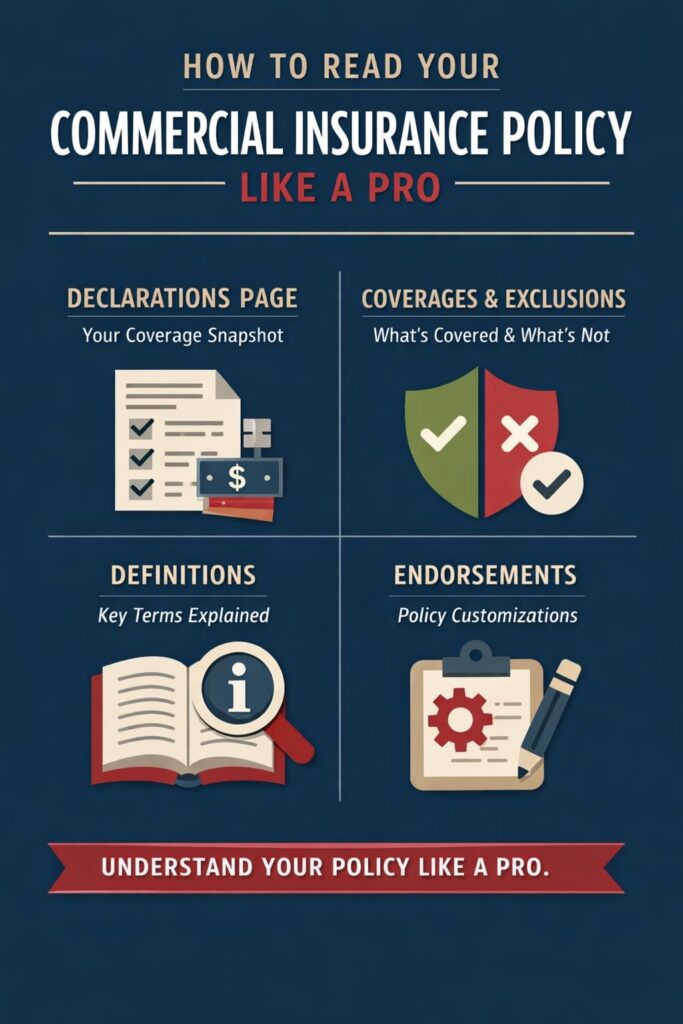
2. Insuring Agreements (What’s Covered)
This section explains:
✔ What risks the policy covers
✔ Under what conditions coverage applies
For example:
- Property insurance covers physical damage to buildings and contents
- General liability covers bodily injury or property damage to others
- Cyber insurance covers certain data breaches and cyber incidents
Think of this as the “promise” the insurance company is making.
3. Definitions (The Language Decoder)
Insurance policies use very specific wording.
A single term like “occurrence,” “property damage,” or “employee” can have a precise legal meaning that impacts claims.
Why this matters:
What you think a word means and what the policy defines it as may be different.
Always review the definitions section — it often determines how coverage applies.
4. Exclusions (What’s Not Covered)
This section outlines situations or losses the policy will not pay for.
Common commercial exclusions can include:
- Certain natural disasters (unless endorsed)
- Wear and tear
- Intentional acts
- Specific industry risks
Important:
Exclusions don’t mean you can’t insure these risks — they often require separate policies or endorsements.
This is where many coverage gaps are found.
5. Conditions (Your Responsibilities)
This section explains what you must do to keep coverage valid, such as:
- Reporting claims promptly
- Maintaining safety procedures
- Cooperating with investigations
- Paying premiums on time
Failure to follow these conditions can impact claim payments.
6. Endorsements & Riders (Custom Changes)
Endorsements modify the standard policy.
They can:
✔ Add coverage
✔ Remove coverage
✔ Adjust limits
✔ Change exclusions
Examples include:
- Cyber liability endorsements
- Hail or wildfire deductibles
- Additional insured endorsements
Always review endorsements carefully — they often make the biggest difference in real-world coverage.
Common Mistakes Colorado Business Owners Make When Reviewing Policies
🚫 Only looking at the premium
🚫 Skipping exclusions
🚫 Not updating coverage after business growth
🚫 Assuming “standard coverage” fits all risks
🚫 Not reviewing endorsements
Every business in Colorado has unique exposures — especially in industries like construction, manufacturing, professional services, real estate, hospitality, and transportation.
Pro Tips to Review Your Policy Like a Professional
✔ Start with the Declarations Page
✔ Highlight unfamiliar terms and check definitions
✔ Review exclusions carefully
✔ Confirm limits reflect your current business size and assets
✔ Look for endorsements that modify coverage
✔ Ask questions (no policy question is too small)
When to Get Help Reviewing Your Commercial Insurance Policy
Even with a basic understanding, commercial policies can be complex.
You should always request a professional review when:
- Your business expands or changes operations
- You purchase new equipment or property
- You hire more employees
- You add vehicles or new locations
- You experience a claim
- You’re renewing coverage
A proactive review helps ensure your coverage keeps up with your business — not yesterday’s version of it.
How Conexus Helps Colorado Businesses Make Sense of Their Insurance
At Conexus Insurance, we believe insurance should be clear, strategic, and built around your business — not just sold and forgotten.
Our consultative approach means we:
- Break down policies in plain language
- Help identify potential coverage gaps
- Work to align coverage with your business goals
- Provide ongoing reviews — not just annual renewals
We work with Colorado businesses across industries to build customized commercial insurance programs that protect what matters most.
Ready for a Commercial Policy Review?
If you’re unsure whether your current policy fully protects your business — or if you simply want a clearer understanding of your coverage — we’re here to help.
👉 Schedule a complimentary commercial insurance review with a Conexus insurance advisor today.