

Employee Benefits and Health Insurance: Why Your Health Insurance Renewal Keeps Increasing (and What You Can Do About It)
If your employee benefits and health insurance renewal feels higher every year—you’re not imagining it.
Across Colorado and nationally, employers are seeing consistent increases in health insurance costs. And while it’s easy to chalk it up to “just the market,” the reality is more nuanced—and more actionable.
Understanding why your renewal is increasing is the first step toward managing it.
What’s Driving Health Insurance Increases?
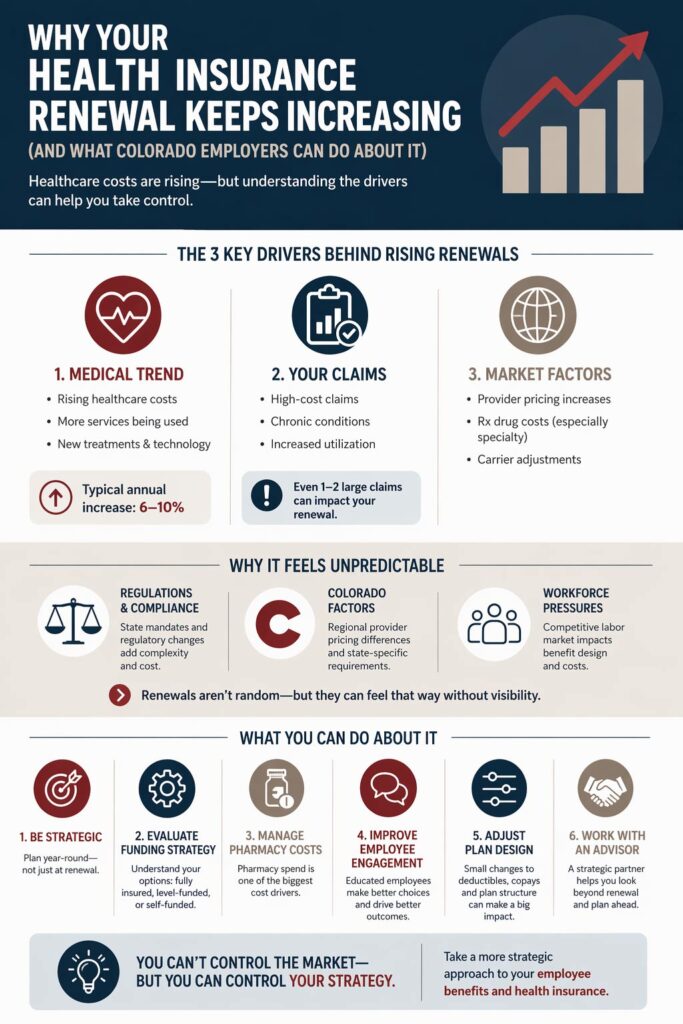
There isn’t a single cause. Most renewals are influenced by a combination of three key factors: medical trend, your claims experience, and broader market dynamics.
1. Medical Trend: The Baseline Increase
“Medical trend” is the industry term for the expected annual increase in healthcare costs.
This includes:
- Rising hospital and provider costs
- Increased utilization of services
- New technologies and treatments
- Inflation in the healthcare system
In most years, employers can expect a baseline trend in the 6–10% range—before any group-specific factors are applied.
2. Claims Experience: Your Group’s Impact
Your employees’ actual healthcare usage plays a significant role in your renewal—especially for level-funded or self-funded plans.
Common drivers include:
- High-cost claims (e.g., surgeries, specialty medications)
- Ongoing chronic conditions
- Increased utilization of services
Even one or two large claims can meaningfully impact renewal outcomes, particularly for small to mid-sized groups.
Important note: Employers typically receive aggregated, de-identified data—not individual medical details—due to privacy regulations.
3. Market & Carrier Factors
Insurance carriers also adjust pricing based on broader conditions, including:
- Network and provider contract increases
- Prescription drug trends (especially specialty medications)
- Regulatory changes and compliance costs
- Risk pooling and underwriting adjustments
These factors can impact your renewal even if your internal claims are relatively stable.
Why This Matters for Colorado Employers
For employers in Colorado, additional considerations can influence costs, including:
- Regional provider pricing differences
- State-specific regulations and mandates
- Competitive labor market pressures impacting benefit design
The result? Renewals that can feel unpredictable without the right visibility and strategy.
What You Can Do About It
While you can’t control every variable, you can take a more proactive approach to managing your benefits strategy.
1. Move from Reactive to Strategic Planning
If your only touchpoint is at renewal, you’re already behind.
Instead:
- Review claims and utilization throughout the year
- Identify cost drivers early
- Build a multi-year benefits strategy
This shifts the conversation from “What are we getting?” to “What are we building?”
2. Evaluate Your Funding Strategy
Your plan type matters more than many employers realize.
Options to explore:
- Fully insured
- Level-funded
- Self-funded (for larger groups)
Each comes with different levels of cost control, risk, and transparency. The right fit depends on your size, goals, and risk tolerance.
3. Focus on Pharmacy Spend
Prescription drugs—especially specialty medications—are one of the fastest-growing cost drivers.
Consider:
- Reviewing your pharmacy benefit manager (PBM) arrangement
- Evaluating formulary and utilization controls
- Exploring cost-containment strategies
This is often one of the most overlooked opportunities for savings.
4. Improve Employee Engagement & Utilization
A well-designed plan only works if employees understand and use it effectively.
Practical steps:
- Clear, consistent communication
- Education on plan options and resources
- Encouraging use of preventive care and lower-cost options
5. Benchmark and Reassess Plan Design
Small adjustments can make a meaningful difference.
Examples include:
- Contribution strategies
- Deductible and out-of-pocket structures
- Ancillary benefits alignment
The goal isn’t just to cut costs—it’s to align your plan with your workforce and business objectives.
6. Work with an Advisor—Not Just a Broker
There’s a difference between placing a plan and managing a strategy.
An effective partner should help you:
- Understand your data
- Identify opportunities
- Build a long-term approach—not just shop the market annually
A Different Way to Think About Renewals
Renewals don’t have to feel like a surprise—or a one-time event.
They’re the result of decisions, trends, and strategy (or lack of one) throughout the year.
When you understand the drivers—and take a proactive approach—you can move from reacting to increases…to managing them.
Looking Ahead
Healthcare costs will likely continue to rise. That’s the reality of the market.
But with the right visibility, structure, and strategy, Colorado employers can make more informed decisions—and create a benefits program that supports both their people and their business.
If you’re looking to take a more strategic approach to your employee benefits and health insurance, our team is here to help guide the conversation.