
If you haven’t updated your building values in 2–3 years…you may be underinsured.
For many Colorado business owners, property insurance is set once—and rarely revisited. But the reality is this: the number on your policy may no longer reflect what it would actually cost to rebuild your building today.
And that gap can create real financial exposure.
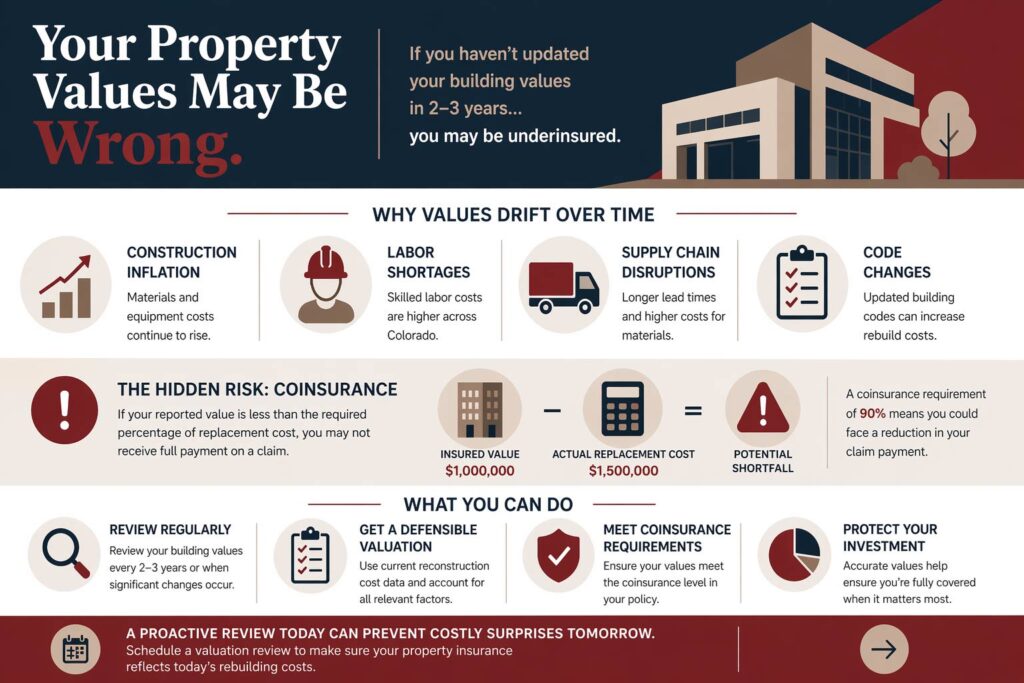
Why Building Values Drift Over Time
Property values used for insurance purposes are not based on market value or purchase price. They are based on reconstruction cost—what it would take to rebuild your structure with like kind and quality at today’s prices.
Over the past several years, those costs have changed significantly due to:
- Construction inflation: Materials like lumber, steel, and concrete have seen price volatility
- Labor shortages: Skilled labor costs have increased across Colorado
- Supply chain disruptions: Longer timelines and higher costs for materials and equipment
- Local building code changes: Rebuild requirements may be more expensive than when your property was originally constructed
If your values haven’t been reviewed recently, there’s a strong chance they’re no longer aligned with reality.
The Hidden Risk: Coinsurance Penalties
Many commercial property policies include a coinsurance clause, typically requiring you to insure your building to 80%, 90%, or 100% of its replacement cost.
If your reported value falls short, even unintentionally, you may not receive full payment on a claim.
Here’s how that can play out:
- You insure your building for $1,000,000
- Actual reconstruction cost is $1,500,000
- Your policy requires 90% coinsurance
You’re effectively underinsured—and in the event of a partial loss, the carrier may reduce the claim payment proportionally.
This is often one of the most surprising (and frustrating) outcomes for business owners who believed they were adequately covered.
Common Misconceptions About Property Values
We regularly see well-intentioned decisions that lead to inaccurate valuations:
- “We’ll just insure it for what we paid.”
Purchase price reflects market conditions—not reconstruction cost. - “We increased it a little each year, so we’re fine.”
Incremental increases may not keep pace with actual cost changes. - “Our lender required this amount.”
Loan requirements are often based on protecting the lender—not fully insuring your exposure.
What a Proper Valuation Looks Like
A defensible building value should consider:
- Square footage and construction type
- Quality of materials and finishes
- Unique features or specialty equipment
- Local labor and material costs
- Debris removal and soft costs (architects, permits, etc.)
At Conexus, we use industry-recognized valuation tools and work with you to validate assumptions—so your numbers are aligned with today’s environment.
A Simple (and Important) Next Step
If it’s been 2–3 years or more since your last valuation review, it’s worth revisiting—especially in a market like Colorado where construction costs have shifted.
A proactive review can help you:
- Avoid coinsurance penalties
- Ensure claims are paid as expected
- Align coverage with your actual risk
Schedule a Valuation Review
If you’d like a second look at your current property values, we’re here to help.
We’ll walk through your existing assumptions, benchmark against current reconstruction data, and identify any gaps—so you can move forward with clarity and confidence.
This content is provided for informational purposes only and is not intended to modify or replace the terms, conditions, or exclusions of any insurance policy. Coverage determinations are subject to the specific policy language and underwriting guidelines.