
For Colorado businesses with vehicles on the road every day, managing commercial auto risk is about more than having the right insurance policy. It’s also about reducing accidents before they happen and having better information when they do.
That’s where fleet safety technology is changing the conversation.
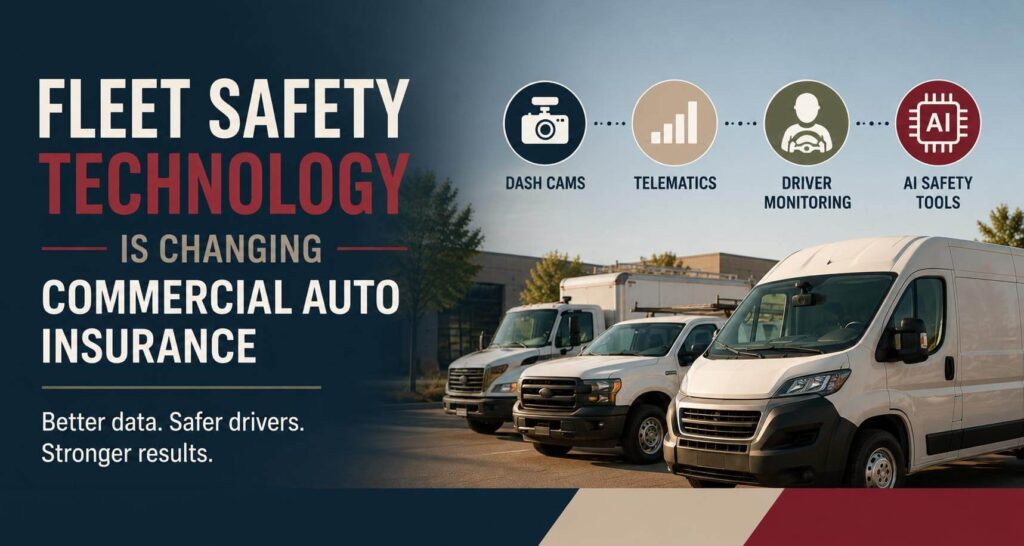
Dash cams, telematics, driver monitoring, and AI-powered safety tools can give businesses greater visibility into how their vehicles are being driven. These tools may help identify risky behavior, improve driver coaching, and provide valuable information following an accident.
They may also play a role in how insurance carriers evaluate a company’s overall commercial auto risk.
Why Fleet Safety Matters to Colorado Businesses
Whether your business operates three service trucks around Denver or a larger fleet traveling throughout Colorado, every mile driven creates potential exposure.
Vehicle accidents can result in property damage, injuries, liability claims, downtime, and lost productivity. Claims history, driver records, vehicle types, radius of operation, and other factors may also affect how an insurance carrier evaluates and prices commercial auto insurance.
For many businesses, that makes preventing accidents just as important as insuring against them.
Dash Cams Can Provide Valuable Information After an Accident
After an accident, determining exactly what happened isn’t always straightforward. Drivers and witnesses may remember events differently, and there may be limited evidence available.
Dash cameras can provide another source of information.
Depending on the system, cameras may record the road ahead, the vehicle interior, or multiple angles around the vehicle. Some systems can also flag events such as sudden braking, following too closely, or distracted driving.
That footage may be useful when investigating an accident or responding to a claim. It doesn’t automatically determine fault or guarantee a particular claim outcome, but it can provide additional documentation about what occurred.
Telematics and Driver Monitoring Can Help Identify Risk
Telematics gives businesses information about how company vehicles are being operated. Depending on the technology, employers may be able to monitor speed, hard braking, rapid acceleration, mileage, routes, idle time, seat belt use, and other driving behaviors.
Newer driver-monitoring and AI-powered systems can go even further. Some can identify potential distracted driving, mobile phone use, drowsiness, or unsafe following distances and alert the driver in real time.
The value isn’t simply collecting the data. It’s what a business does with it.
If telematics repeatedly identifies speeding or hard braking, for example, management can address the behavior through coaching or additional training before it contributes to an accident.
Businesses using driver-monitoring technology should also consider employee communication, privacy, data security, and any applicable employment or privacy requirements.
Can Fleet Safety Technology Lower Commercial Auto Insurance Premiums?
Possibly, but installing technology does not automatically mean your commercial auto insurance premium will go down.
Insurance carriers have different underwriting guidelines, rating methodologies, programs, and eligibility requirements. Some carriers may consider fleet safety practices or offer programs involving telematics and other technology, while others may place greater emphasis on factors such as claims history, driver records, vehicle types, and operations.
The bigger opportunity is often long-term risk improvement.
A company that uses fleet data to coach drivers, enforce safety policies, and reduce preventable accidents may be able to improve its overall risk profile over time. Fewer or less severe claims can be beneficial when an insurance carrier evaluates the account, although no particular technology or safety program guarantees lower premiums.
That’s an important distinction for Colorado businesses considering an investment in fleet technology.
Better Data Can Help With Commercial Auto Claims
Fleet technology can also become valuable after an accident.
Imagine one of your employees is driving a company vehicle on I-25 when another vehicle changes lanes and a collision occurs. The two drivers may have different accounts of what happened.
Dash-cam footage could provide additional information about the sequence of events, while telematics data might show the company’s vehicle speed or braking activity immediately before the collision.
That information doesn’t guarantee how liability will be determined or how a claim will be resolved, but it may provide useful documentation during the claims investigation.
For businesses with multiple vehicles on Colorado roads every day, having more reliable information after an accident can be valuable.
Technology Works Best With a Strong Fleet Safety Program
Technology alone isn’t a fleet safety program.
Dash cams and telematics are most useful when they’re paired with consistent risk-management practices, such as:
- Written driver and vehicle-use policies
- Driver screening and motor vehicle record reviews
- Regular safety training
- Clear distracted-driving policies
- Vehicle inspection and maintenance procedures
- Accident reporting protocols
- Driver coaching and corrective action
- Regular review of claims and loss trends
The technology can help identify potential problems. The business still has to act on the information.
What Should Colorado Businesses Consider?
There isn’t one fleet safety solution that’s right for every company.
A Colorado contractor with five pickup trucks may have very different needs from a distributor operating dozens of vehicles across several states. Before investing in new technology, consider how your vehicles are used, how much your employees drive, your accident history, and the specific risks you’re trying to address.
It’s also worth involving your commercial insurance advisor in the conversation. Your advisor can help you understand how your current insurance carriers view fleet safety practices, whether carrier-sponsored programs may be available, and how your risk-management strategy fits into your broader commercial auto insurance program.
A Safer Fleet Starts With Better Information
Dash cams, telematics, driver monitoring, and AI safety tools are giving businesses more visibility into what’s happening behind the wheel.
Used effectively, these tools can help identify risky behavior, support driver coaching, provide information after accidents, and strengthen a company’s overall approach to fleet safety.
At Conexus Insurance Partners, we help Colorado businesses look beyond the policy to understand and manage the risks affecting their people and operations. If you’d like to review your commercial auto insurance or talk about ways to strengthen your fleet risk-management strategy, we’re here to help.
People First. People Protected. Power in Partnership.