
If your employee benefits plan is coming up for renewal, there’s a good chance renewal season is getting very real right about now.
Maybe you’ve received your renewal. Maybe you’re waiting for final numbers. Or maybe you’re already looking at spreadsheets trying to figure out how an increase fits into your budget.
It’s tempting to jump straight to one question: How much did our rates go up?
Of course that number matters. But it shouldn’t be the only thing driving your decision.
Your employee benefits package is a significant investment—for your company and your employees. Renewal is your opportunity to look at that investment as a whole and decide whether your current strategy still makes sense.
Before you sign off on your benefits renewal, here are seven questions worth asking.
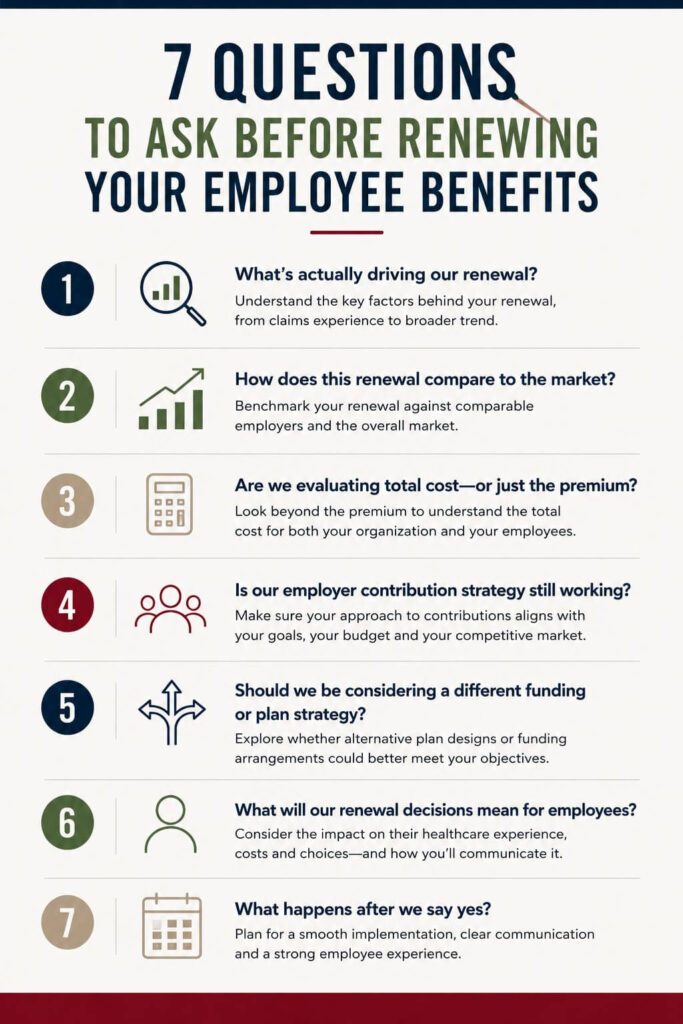
1. What’s actually driving our renewal?
If your medical renewal increased, you should understand why.
Healthcare costs continue to rise, but “medical trend” doesn’t tell the whole story. Depending on the size and type of your plan, several factors may affect your renewal, including claims experience, prescription drug costs, demographic changes, plan utilization, carrier pricing, geographic factors and broader healthcare trends.
The amount of information available will vary by employer and funding arrangement. Smaller fully insured groups, for example, generally won’t have access to the same level of claims detail as larger or self-funded employers.
Your benefits advisor should still be able to help you understand the factors affecting your renewal and put the numbers into context.
Don’t stop at what the renewal is.
Ask why.
2. How does this renewal compare to the market?
A significant increase sounds bad.
But is it?
That’s impossible to answer without context.
If comparable employers are experiencing even larger increases, your renewal may look very different. On the other hand, if your carrier’s pricing isn’t competitive, there may be a reason to explore alternatives.
This is where benchmarking and market knowledge matter.
Look at more than the percentage increase. Consider your plan designs, employer contributions, networks, funding arrangement and overall benefits package.
And remember: going to market isn’t automatically the right answer every year.
Sometimes negotiating with the incumbent carrier makes sense. Sometimes testing the market makes sense. Sometimes staying exactly where you are is the best decision.
The goal isn’t to create activity.
It’s to make a good decision.
3. Are we evaluating total cost—or just the premium?
Premium gets most of the attention during renewal because it’s the easiest number to see.
But it isn’t the only cost that matters.
Take a step back and look at what employees actually experience when they use the plan:
- Deductibles
- Copays
- Coinsurance
- Out-of-pocket maximums
- Prescription drug coverage
- Provider networks
- Employer HSA or HRA contributions, when applicable
- Employee payroll deductions
A plan with a lower premium isn’t necessarily a better plan if employees end up carrying substantially more financial risk when they need care.
The opposite can also be true. Paying more for richer coverage doesn’t automatically mean you’re getting better value.
The better question is:
What are we spending, what are our employees spending, and what are we getting in return?
4. Is our employer contribution strategy still working?
Many employers carry the same contribution strategy forward year after year.
That’s understandable. It’s easy, employees are accustomed to it and changing contributions can be disruptive.
But renewal is a good time to make sure the strategy still works.
Consider questions like:
- Is employee-only coverage still affordable?
- What does dependent coverage cost employees?
- Are we contributing a fixed dollar amount or a percentage?
- How have employee payroll deductions changed over time?
- How does our contribution compare with employers competing for the same talent?
- Does our contribution strategy still fit our compensation philosophy and budget?
There isn’t one contribution formula that’s right for every Colorado employer.
The right approach depends on your workforce, budget, benefits philosophy, plan options and applicable requirements.
What matters is that your contribution is a decision—not simply a number you’ve been carrying forward because that’s what you’ve always done.
5. Should we be considering a different funding or plan strategy?
A difficult renewal doesn’t necessarily mean you should switch carriers or completely redesign your benefits.
But it can be a reason to ask whether you should evaluate other options.
Depending on your organization’s size, risk tolerance, claims experience and objectives, those conversations could include different plan designs, alternative carrier options, level-funded arrangements, self-funding strategies, HSA-compatible plans, HRAs or other approaches.
Not every strategy is appropriate for every employer.
And a lower initial rate doesn’t automatically mean lower long-term cost. Different funding arrangements can involve different levels of financial risk, administrative responsibility, contractual provisions and compliance considerations.
That’s why the conversation should start with your organization—not with a product.
What problem are we trying to solve?
Once you know that, you can evaluate whether a different strategy actually solves it.
6. What will our renewal decisions mean for employees?
This is one of the easiest questions to overlook when you’re deep in renewal spreadsheets.
You may be looking at a percentage increase.
Your employee may be looking at more money coming out of every paycheck, a higher deductible and wondering whether their child’s doctor is still in-network.
Those are two very different perspectives on the same renewal.
Before finalizing changes, look at them through the employee’s eyes.
What will change?
What will it cost?
What choices will employees need to make?
And how are you going to explain it?
If you’re changing carriers, networks, deductibles, prescription coverage or contribution levels, employees need more than a benefits guide dropped into their inbox the day open enrollment begins.
Give them context.
Explain why changes were made. Show them what’s staying the same. Help them understand their options.
Your benefits package has value only if your employees understand how to use it.
7. What happens after we say yes?
Choosing your benefits is a major milestone.
It isn’t the finish line.
Once decisions are made, there is still work to do: implementation, enrollment materials, employee communication, benefits education, carrier coordination and making sure everything is ready for the new plan year.
This is also where a rushed renewal process can create unnecessary headaches.
Before you finalize your renewal, make sure there’s a clear timeline for what happens next.
Who is responsible for what?
When will employees receive information?
When will open enrollment begin and end?
How will employees get their questions answered?
What needs to happen between enrollment closing and the start of the new plan year?
A strong renewal strategy should include the employee experience—not just the carrier decision.
Your Renewal Is More Than a Rate
We know renewal season can feel like a race against the clock.
But this is also one of the best opportunities you’ll have to look at your benefits program with fresh eyes.
Are your plans still competitive?
Are they sustainable?
Do employees understand and value them?
Are you solving the right problems?
And does your current strategy still support where your organization is going?
Those conversations matter far more than simply getting the renewal completed on time.
At Conexus Insurance, we believe employee benefits should support both the people who use them and the businesses that provide them. Our role is to help employers understand their options, ask better questions and make informed decisions about what makes sense for their organization.
Renewal is more than checking a box and moving on. It’s an opportunity to make sure your benefits are still working for your business, your budget and your people.
This article is provided for general informational purposes only and is not intended as legal, tax, accounting or benefits compliance advice. Employee benefit plan requirements and available strategies vary based on employer size, plan structure, funding arrangement and other circumstances. Employers should consult with their appropriate legal, tax and benefits advisors regarding their specific situation.