
How businesses can avoid costly work comp issues and keep employees protected
Workers’ compensation insurance plays a critical role in protecting both employees and employers when workplace injuries occur. In Colorado, most businesses are required to carry workers’ compensation insurance, even if they have only one employee.
Despite this requirement, many employers unintentionally make mistakes that can lead to higher premiums, compliance issues, or complications during a claim. Understanding these common pitfalls can help businesses better manage their workers comp in Colorado and protect their team and operations.
Below are some of the most common workers’ compensation mistakes Colorado employers make—and how to avoid them.
1. Misclassifying Employees
One of the most frequent issues in workers compensation policies involves employee classification.
Workers’ compensation premiums are largely based on job classifications that reflect the risk level of the work performed. For example, office employees typically carry a lower risk classification than construction or manufacturing workers.
Problems can arise when:
- Employees are assigned the wrong classification code
- Duties change over time but classifications are not updated
- Workers are incorrectly treated as independent contractors
Misclassification can result in premium adjustments during audits, penalties, or disputes if a claim occurs. Employers should review classifications regularly and ensure job descriptions accurately reflect employees’ duties.
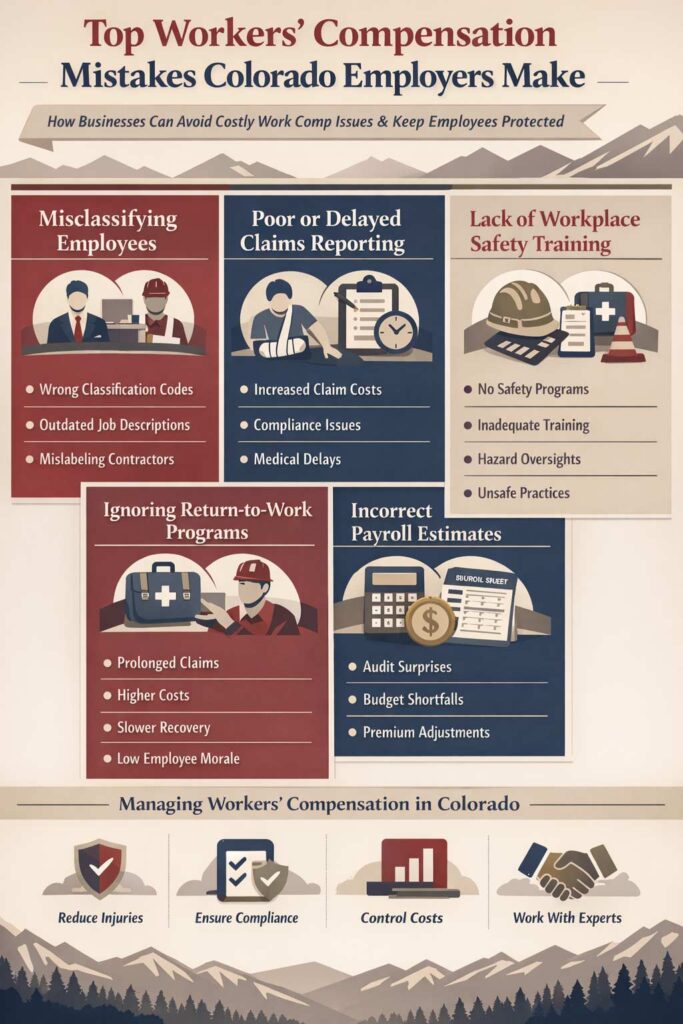
2. Poor or Delayed Claims Reporting
When a workplace injury occurs, timely reporting is essential.
Delays in reporting injuries can lead to:
- Increased claim costs
- Complications with medical treatment coordination
- Potential compliance concerns under Colorado reporting requirements
Employers should encourage employees to report workplace injuries immediately and establish clear internal procedures for notifying supervisors and insurance carriers. Early reporting helps ensure employees receive prompt care and allows the claim process to begin smoothly.
3. Lack of Workplace Safety Training
Preventing injuries is one of the most effective ways to control workers’ compensation costs.
Businesses that do not maintain structured safety programs may see higher claim frequency and severity. In addition to protecting employees, safety initiatives can also improve operational efficiency and morale.
Examples of helpful safety practices include:
- Regular safety training sessions
- Documented safety procedures
- Equipment training and maintenance programs
- Hazard identification and reporting systems
Many insurers also provide safety resources and guidance to help businesses reduce risk and manage work comp exposures.
4. Ignoring Return-to-Work Programs
A structured return-to-work program can be one of the most effective tools for managing workers’ compensation claims.
When employees recover from an injury, modified or light-duty roles may allow them to return to work sooner while still accommodating medical restrictions.
Benefits of return-to-work programs may include:
- Reduced claim duration
- Lower overall claim costs
- Faster employee recovery and reintegration
- Improved morale and retention
Employers who lack a return-to-work plan may unintentionally prolong claims and increase the financial impact of workplace injuries.
5. Incorrect Payroll Estimates
Workers’ compensation premiums are typically calculated based on estimated payroll at the beginning of the policy period. At the end of the term, insurers perform an audit to reconcile the estimate with actual payroll.
If payroll estimates are significantly inaccurate, businesses may face:
- Unexpected premium increases at audit
- Budgeting challenges
- Administrative complications
Employers should work closely with their insurance advisor to ensure payroll estimates are as accurate as possible and that payroll changes throughout the year are communicated appropriately.
Managing Workers’ Compensation in Colorado
Workers’ compensation requirements and regulations in Colorado can be complex, and mistakes—especially around classification, claims reporting, and payroll—can create unnecessary risk for employers.
By taking a proactive approach to workers’ compensation management, businesses can:
- Reduce workplace injuries
- Improve claims outcomes
- Maintain compliance with Colorado regulations
- Better control insurance costs over time
Working with an experienced insurance advisor can help ensure your workers comp program aligns with your business operations and risk profile.
Need Guidance on Workers’ Compensation Coverage?
Every business has unique risks, and workers’ compensation insurance in Colorado should be structured to reflect the realities of your operations and workforce.
If you have questions about workers’ compensation requirements, classifications, or risk management strategies, the team at Conexus Insurance is here to help.
Our advisors work closely with Colorado businesses to design workers comp programs that support both employee safety and long-term business stability.