

Health insurance costs continue to be one of the biggest concerns for Colorado employers. As premiums rise and employees look for more flexibility in their benefits, many businesses are taking a closer look at Health Savings Accounts (HSAs) as part of their employee benefits strategy.
But what exactly is an HSA? How does it work alongside health insurance? And how can employers use HSAs strategically—not just as a cost-control tool, but as a meaningful employee benefit?
What Is an HSA?
A Health Savings Account (HSA) is a tax-advantaged savings account that allows eligible individuals to set aside money for qualified medical expenses.
HSAs are only available when an employee is enrolled in a qualified High Deductible Health Plan (HDHP).
Employees can use HSA funds for eligible healthcare expenses such as:
- Doctor visits
- Prescriptions
- Dental care
- Vision expenses
- Mental health services
- Certain over-the-counter medical items
Unlike a Flexible Spending Account (FSA), unused HSA funds generally roll over year after year and remain with the employee even if they change jobs.
For many employees, an HSA can function as both a healthcare spending tool and a long-term savings vehicle.
How Does an HSA Work with a High Deductible Health Plan (HDHP)?
An HSA must be paired with an eligible HDHP.
Typically, HDHPs:
- Have lower monthly premiums
- Have higher deductibles
- Shift more upfront healthcare costs to the employee before insurance begins paying
The HSA helps offset those out-of-pocket costs by allowing employees to use pre-tax dollars for qualified medical expenses.
For employers, this combination can create opportunities to:
- Reduce overall premium costs
- Offer employees more choice
- Create a more consumer-driven healthcare experience
- Redirect savings into employer HSA contributions or other benefits
That said, HDHPs are not the right fit for every workforce. Plan design decisions should consider employee demographics, healthcare utilization, wage levels, and overall benefits philosophy.
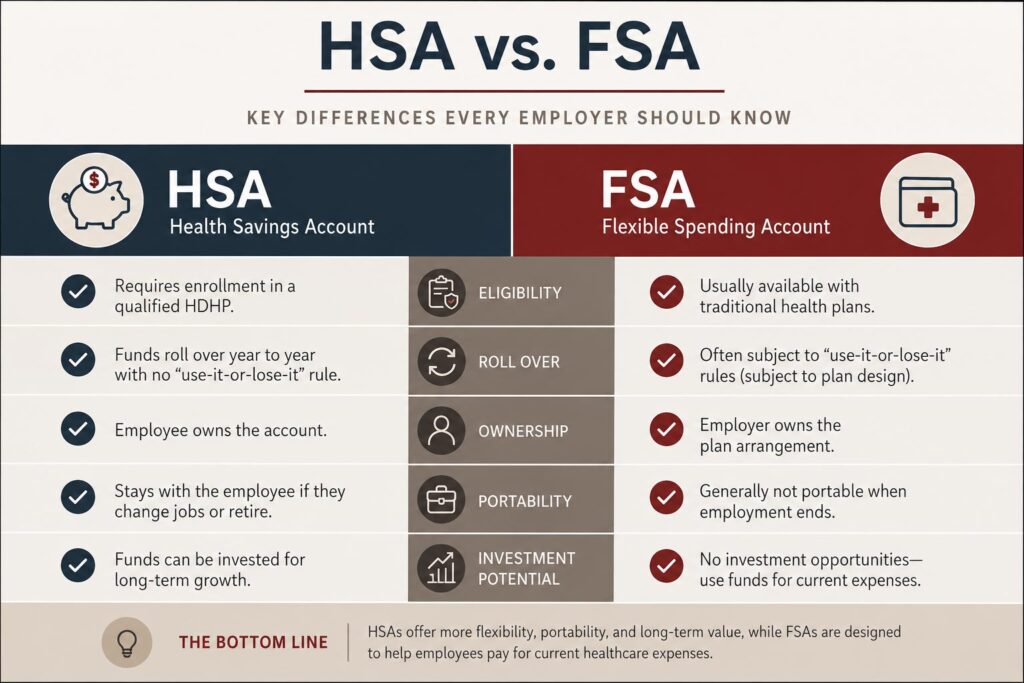
HSA vs. FSA: What’s the Difference?
One of the most common questions employers ask is: “What’s the difference between an HSA and an FSA?”
While both accounts offer tax advantages for healthcare expenses, they operate differently.
HSA
- Requires enrollment in a qualified HDHP
- Funds generally roll over year to year
- Employee owns the account
- Portable if the employee leaves the company
- Can potentially be invested for long-term growth
FSA
- Usually available with traditional health plans
- Often subject to “use-it-or-lose-it” rules (subject to employer plan design allowances)
- Employer owns the plan arrangement
- Typically not portable when employment ends
In some situations, employers may offer limited-purpose FSAs alongside HSAs for eligible dental and vision expenses.
Because IRS rules can be complex, employers should work closely with their employee benefits advisor, payroll provider, and tax professionals when structuring these arrangements.
What Are the Tax Advantages of an HSA?
HSAs are often referred to as offering a “triple tax advantage.”
1. Employee Contributions Are Generally Pre-Tax
Contributions made through payroll deductions are generally excluded from federal taxable income.
2. Earnings Can Grow Tax-Advantaged
Interest and investment earnings within the account can accumulate tax-free when used for qualified expenses.
3. Qualified Withdrawals Are Generally Tax-Free
Employees generally do not pay federal income tax on distributions used for eligible healthcare expenses.
Employers may also realize payroll tax savings when employees contribute through a cafeteria plan arrangement.
State tax treatment can vary, and employers should confirm how HSAs are treated under applicable state and federal tax laws.
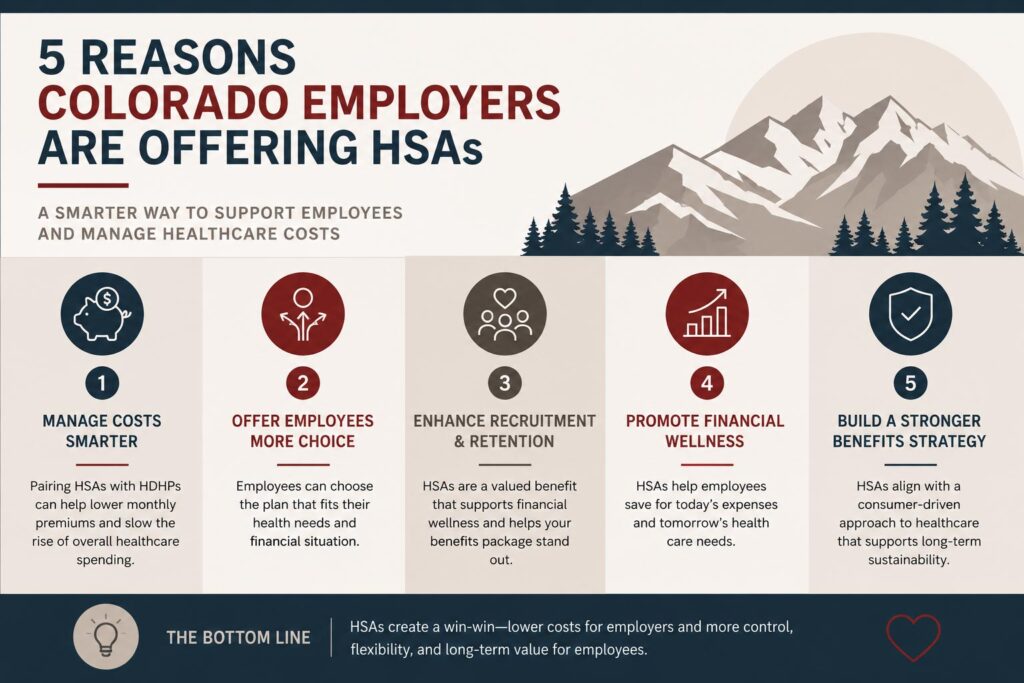
Why Are More Colorado Employers Offering HSAs?
Many Colorado businesses are using HSAs strategically as part of broader employee benefits planning—not simply as a way to reduce premiums.
Common reasons employers explore HSAs include:
✔ Budget Management
HDHPs often come with lower premium costs than traditional PPO plans, helping employers manage healthcare spending.
✔ Employee Choice
Offering multiple plan options can help employees select coverage that aligns with their healthcare needs and financial situation.
✔ Recruitment and Retention
Employees increasingly value flexibility, portability, and financial wellness tools within benefits packages.
✔ Long-Term Financial Wellness
Some employees use HSAs as supplemental retirement healthcare savings because unused balances can continue accumulating over time.
Employer HSA Contribution Strategies
Employer contributions can play a significant role in employee adoption and satisfaction.
There is no one-size-fits-all approach, but common contribution strategies include:
Flat Employer Contributions
Providing all eligible employees with the same fixed annual contribution amount.
Tiered Contributions
Offering different contribution amounts based on:
- Employee-only vs. family coverage
- Compensation structure
- Participation in wellness initiatives
Seed Contributions
Employers contribute funds at the beginning of the plan year to help employees manage early deductible expenses.
Payroll-Based Matching
Some employers match a portion of employee HSA contributions up to a defined amount.
Employers should carefully evaluate:
- Budget impact
- Nondiscrimination considerations
- Workforce demographics
- Participation goals
- Communication and education needs
A poorly communicated HSA strategy can create confusion for employees unfamiliar with HDHPs or healthcare savings accounts.
Questions Colorado Employers Should Ask Before Offering an HSA
Before implementing an HSA-compatible health plan, employers may want to evaluate:
- Is our workforce financially prepared for higher deductibles?
- Are we clearly educating employees on how HSAs work?
- Should we contribute to employee HSAs?
- Would an HDHP complement or replace our current plans?
- Are our payroll and benefits systems set up correctly for HSA administration?
- How does this align with our long-term employee benefits strategy?
These conversations are especially important for small and mid-sized businesses balancing affordability with competitive benefits offerings.
Final Thoughts
HSAs can be a valuable tool for both employers and employees when implemented thoughtfully.
For Colorado employers, the right HSA strategy is not just about lowering premiums. It is about creating a benefits program that supports employee financial wellness, improves flexibility, and aligns with overall business goals.
Like any employee benefits decision, plan design matters. Contribution strategies, employee education, compliance considerations, and workforce demographics all play an important role in determining whether an HSA-compatible plan is the right fit.
At Conexus Insurance, we help Colorado employers evaluate employee benefits strategies that balance cost management, employee experience, and long-term sustainability.
his article is intended for general informational purposes only and should not be construed as legal, tax, financial, or employee benefits advice. HSA eligibility, contribution limits, tax treatment, and compliance requirements may vary based on individual circumstances and applicable federal and state laws. Employers should consult with qualified legal, tax, employee benefits, and HR professionals before making decisions regarding health plans, HSAs, FSAs, or employee benefits strategies.