
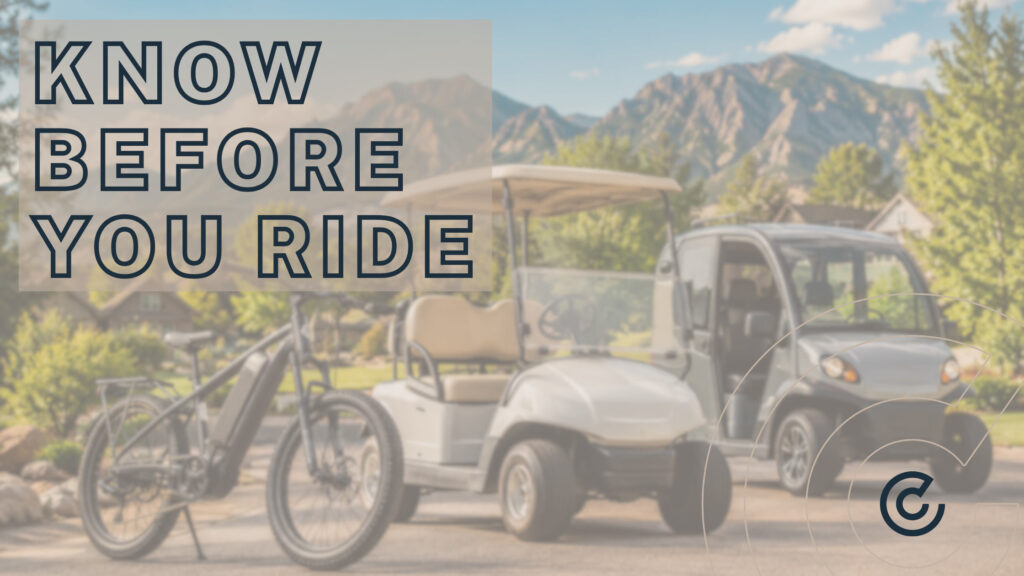
They’re everywhere across Colorado. But many owners assume they’re automatically covered by their homeowners or auto insurance. That assumption can become an expensive mistake.
Electric bikes, golf carts, and low-speed vehicles (LSVs) have become increasingly popular for commuting, neighborhood errands, campground travel, and getting around golf communities. They’re convenient, fun, and often less expensive than a traditional vehicle.
The insurance side, however, isn’t always straightforward.
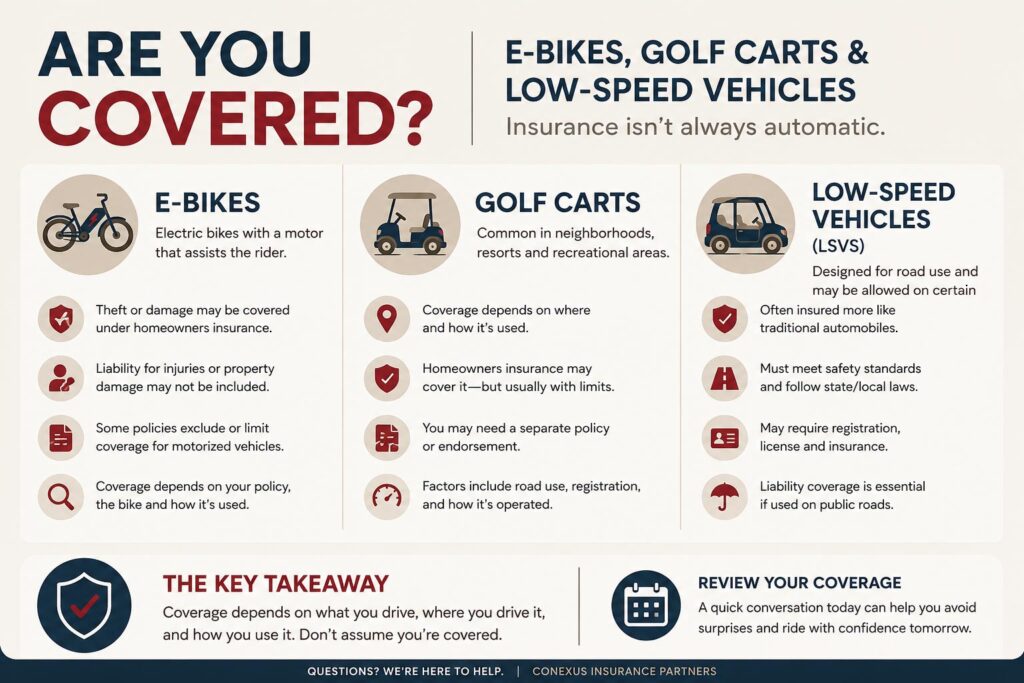
Coverage depends on what you’re driving, where you’re driving it, and how you’re using it. Understanding the differences can help you avoid unexpected coverage gaps if an accident happens.
What Is an E-Bike?
An e-bike is a bicycle equipped with an electric motor that assists the rider while pedaling. Some models provide assistance only while pedaling, while others include a throttle.
Not all e-bikes are treated the same under insurance policies. Factors such as speed, motor power, and state regulations can affect how coverage applies.
Is My E-Bike Covered?
The answer depends on your insurance policy and the circumstances of a loss.
For example:
- Theft from your garage may be covered under your homeowners insurance, subject to your policy terms, deductible, and any applicable limits.
- Damage from a covered peril, such as fire, may also be covered under your homeowners policy.
- Liability for injuries or property damage while riding may not be covered the way many people expect.
- Some policies exclude or limit coverage for motorized vehicles, even if they resemble bicycles.
Because policies vary, it’s important to review how your specific carrier defines and covers electric bicycles.
Are Golf Carts Covered by Insurance?
Golf carts have become common in neighborhoods, planned communities, resorts, campgrounds, and recreational properties throughout Colorado.
Many people assume their homeowners insurance automatically covers a golf cart. Sometimes it does—but only in limited situations.
Coverage often depends on questions like:
- Is the golf cart being used on a golf course?
- Is it being driven on private property or public roads?
- Is it registered for road use?
- Is it being used for recreation, transportation, or business?
If you’re driving your golf cart around your neighborhood, to community events, or on designated streets, you may need a separate golf cart insurance policy or an endorsement to your existing coverage.
What Is a Low-Speed Vehicle (LSV)?
Low-speed vehicles look like golf carts but are designed differently.
An LSV is typically manufactured to meet federal safety standards and may include features such as:
- Seat belts
- Headlights and brake lights
- Turn signals
- Mirrors
- Windshield
- Vehicle Identification Number (VIN)
Depending on Colorado laws and local regulations, properly equipped LSVs may be permitted on certain public roads with posted speed limits within the allowable range.
Because they are designed for road use, LSVs are often insured more like traditional automobiles than golf carts.
Why Insurance Gets Confusing
One of the biggest misconceptions is that these vehicles all fit into the same insurance category.
They don’t.
An e-bike, golf cart, and low-speed vehicle can each have very different insurance requirements. Even two vehicles that look nearly identical may be insured differently based on:
- Vehicle classification
- Top speed
- Motor size
- Registration requirements
- Where the vehicle is operated
- How it is used
- The language within your insurance policy
That’s why there isn’t a one-size-fits-all answer.
Questions to Ask Your Insurance Advisor
- Is my vehicle covered for physical damage?
- Do I have liability coverage if I injure someone or damage property?
- Are there any exclusions based on where I ride or drive?
- Do I need to schedule the vehicle or purchase a separate policy?
- Are accessories, batteries, or custom upgrades covered?
- Does my umbrella policy provide any additional protection?
A short conversation today can prevent costly surprises later.
The Bottom Line
Colorado families are embracing e-bikes, golf carts, and low-speed vehicles for recreation and everyday transportation. As these vehicles become more common, it’s important to understand that insurance coverage isn’t automatic or identical across every policy.
The best approach is to review your current coverage before you need it. That way, you can enjoy the ride with confidence, knowing you understand how your insurance applies.
Need Help Reviewing Your Coverage?
If you have questions about how your homeowners, auto, or umbrella insurance applies to an e-bike, golf cart, or low-speed vehicle, the team at Conexus Insurance Partners is here to help.
We’ll review your current policies, explain any potential coverage gaps, and help you determine whether additional protection makes sense for your situation—so you can make informed decisions with confidence.